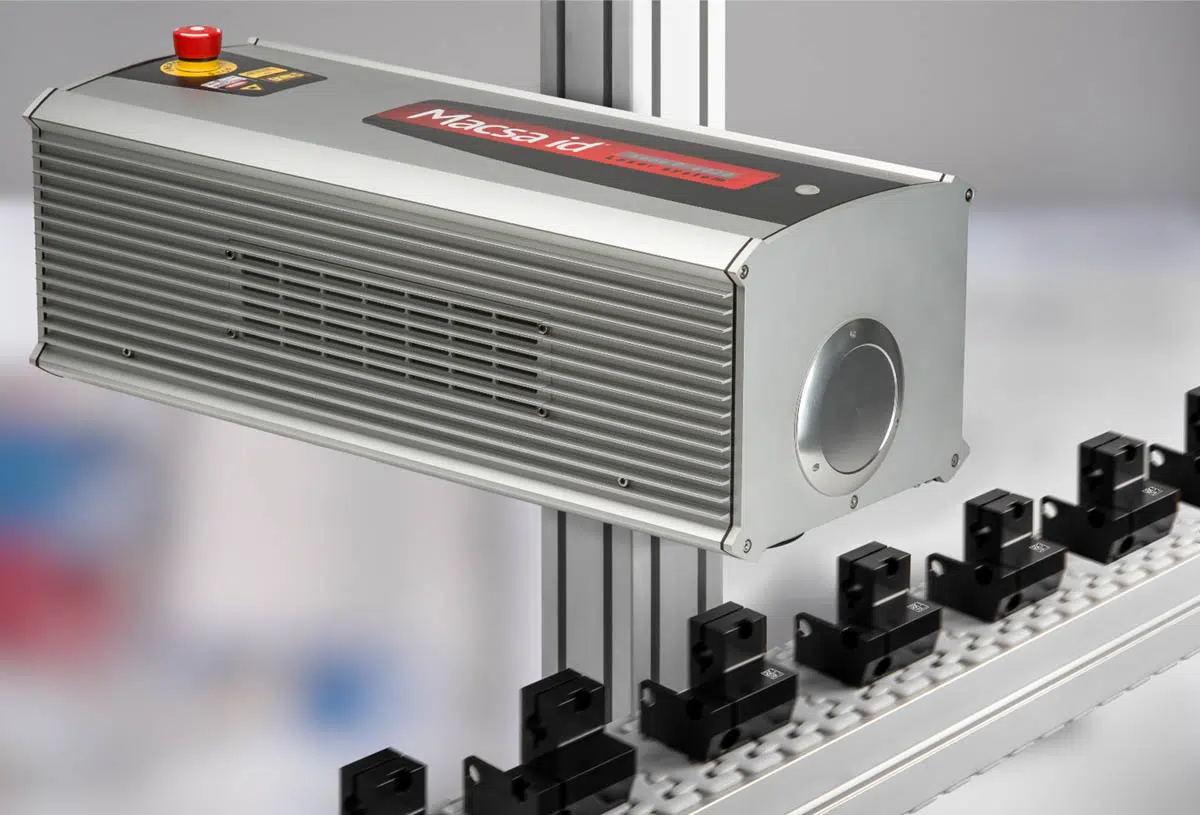
Steel laser marking enables manufacturers to identify components directly with serial numbers, batch data, logos and machine-readable codes. Macsa id assesses the steel grade, surface condition, required mark and production process to recommend the most suitable laser solution.
Steel laser marking enables manufacturers to apply traceability data directly to components, tools, packaging and industrial parts. Serial numbers, references, batch codes, logos and 2D codes can be marked without inks, labels or physical contact with the surface.
At Macsa id, we develop fibre laser marking solutions for stainless steel, carbon steel, tool steel and selected alloys. The right configuration depends on the steel grade, surface finish, required contrast, code-verification criteria and production cycle time.
Laser marking can help maintain the identity of a steel component throughout manufacturing, assembly, quality control, maintenance and after-sales service.
Typical applications include:
Where a GS1 DataMatrix code is required, its structure and data content should follow the relevant GS1 barcode standards.
Fibre laser technology is a common choice for marking many steel components. It can create clear text, codes and graphics with the process control required for industrial applications.
As a non-contact process, fibre laser marking does not require inks, solvents, ribbons or labels. It can be integrated into automated lines or used in a workstation for static parts, smaller batches and semi-automatic operations.
Learn more about the SPA2 F PULSED fibre laser for metal substrates.
On compatible stainless steels and selected alloys, laser annealing can create a dark mark with no intentional material removal. It can be suitable where a smooth surface is important, such as components subject to regular cleaning or applications with specific surface-finish requirements.
The final result should always be validated against the expected cleaning, corrosion, handling and production conditions.
Etching and engraving intentionally modify or remove part of the surface to create a more pronounced mark. They can be appropriate when greater mark depth, contrast or resistance to subsequent handling is required.
The suitable process depends on the steel grade, component geometry, required finish and downstream manufacturing operations.
Steel laser marking is used in many industrial sectors where reliable identification is essential:
For broader material comparison, visit our metal laser marking solutions page. You can also explore our automotive marking solutions.
Macsa id laser systems can be configured for in-line marking or installed in an iLaserBox workstation for static components and semi-automatic applications.
The final solution is defined according to the available space, part handling method, cycle time, automation level, safety requirements and code-verification needs.


Different steel grades, finishes and heat treatments can produce different results. Before implementing a solution, Macsa id can assess a real sample to validate the mark effect, contrast, code legibility and cycle time.
Send us your part and marking requirements to identify the most suitable steel laser marking solution for your process.