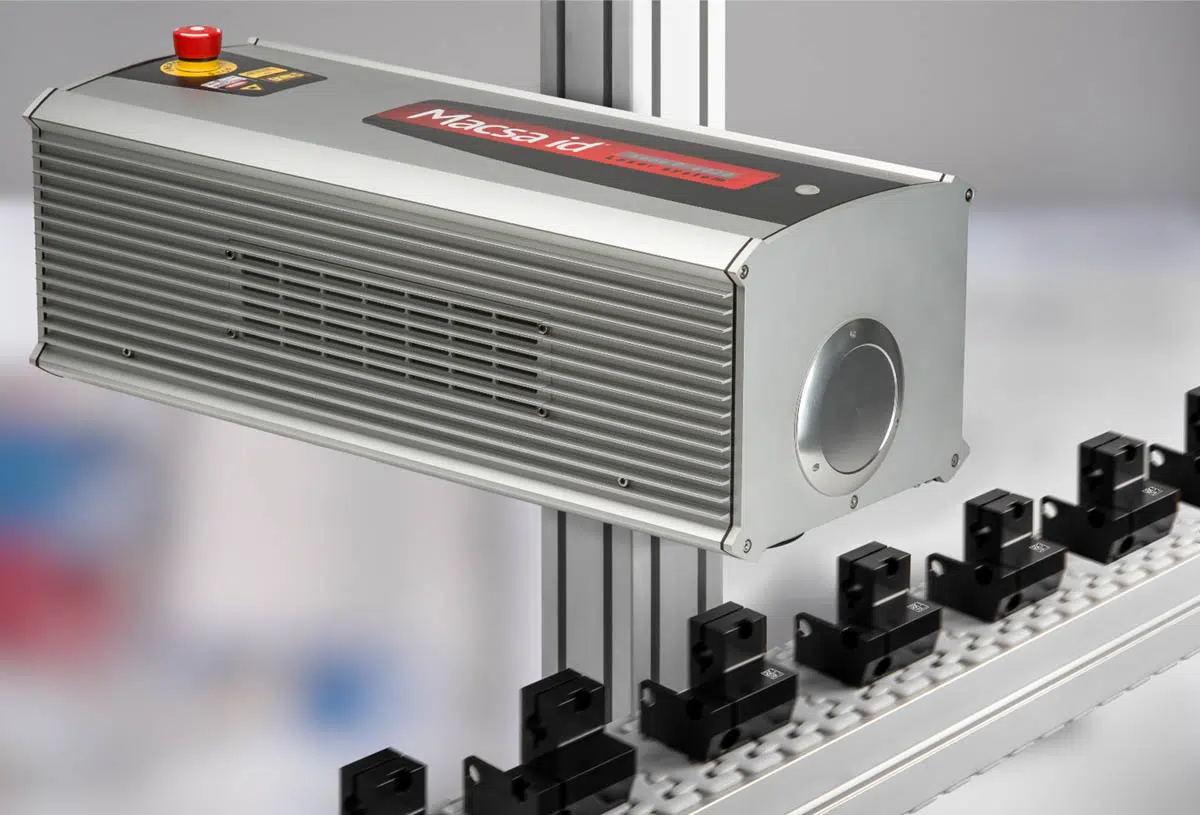
Macsa id industrial laser marking systems apply serial numbers, 2D codes, logos and technical information directly onto suitable components and products. They support permanent identification without physical contact or the transfer of ink to the part.
The range includes D-5000 DUO UV, D-5000 DUO Green, D-5000 DUO and Nano DPSS systems. We assess the material, surface finish, code requirements and production conditions before recommending the most suitable configuration.
Laser marking creates information directly on the selected area of a component. Depending on the material and the required result, it can produce a controlled colour change, a surface mark or a more defined engraved identification.
Typical applications include:
Where 2D codes support supply-chain traceability, their structure and quality can be defined in line with applicable GS1 standards.
Not every material responds in the same way to laser energy. The source, optics and parameters must be selected according to the component, required contrast, code size, geometry and production cycle.
The D-5000 DUO UV Series is a 355 nm DPSS laser designed for high-precision marking on thermoformed and technical plastics. It can be assessed for applications where detail, code quality and controlled marking are key requirements.
The D-5000 DUO Green Series is designed for selected plastic-marking applications that require a clear and defined result. Material composition, colour and additives should be tested before implementation.
The D-5000 DUO Series and Nano DPSS provide options for industrial marking applications with different levels of precision, integration and production requirements.
Industrial laser marking is not only defined by the laser source. Part handling, code data, line communication, cycle time and verification all affect the final result.
Depending on the selected system and configuration, Macsa id solutions can include high-resolution optics, DUO dual-processor technology, Vibration Compensation System (VCS) and 3D marking capabilities. These options are specified according to the application rather than applied as standard to every model.
Systems can be configured for integration into automated production lines or for use with laser marking workstationswhen parts require static or semi-automatic marking.
Our systems can be assessed for applications involving:
Explore our material-specific solutions for engineering plastics and metal laser marking.